
Building monitoring via LoRaWAN
Monitor and optimize buildings efficiently
The digitalization of buildings is becoming increasingly important. Rising energy costs, stricter efficiency requirements, and the desire for greater transparency in building operations are leading operators to increasingly rely on smart monitoring solutions.
As a result, technical building monitoring has become an indispensable tool for monitoring and optimizing building infrastructure in recent years.
The rapid development of modern sensor technologies and the integration of the Internet of Things (IoT) are also contributing to the fact that buildings today are becoming increasingly smart and energy-efficient.
What is building monitoring?
Building monitoring is a surveillance system that monitors the operation and safety of a building. This is made possible through the use of sensors, cameras, software and other technologies. This allows data to be collected and analyzed in real time or at regular intervals. The knowledge gained from this can be used to optimize building technology, reduce energy consumption and operating costs, and enhance building security.
From energy management and indoor air quality to security monitoring and control of HVAC systems, modern building monitoring provides a comprehensive, real-time view of a building’s performance and condition. Today, the possibilities extend far beyond simple alarm systems or thermostats.
The main benefits of building monitoring include:
- Improved efficiency: optimized operation and thus reduction of energy and resource consumption.
- Lower operating costs: Reduction of operating and maintenance costs through more efficient use of resources.
- Improved security: Appropriate monitoring systems can avert burglaries, vandalism, fires and other dangers in good time.
- Increasing comfort: Continuous monitoring of indoor air quality increases comfort and can prevent damage to the building such as mold growth.
- Early detection of technical problems: Leaks, malfunctions and overloads of the technical building infrastructure can be detected at an early stage before they lead to major damage.
- Improved documentation and tracking: Building monitoring data can be used to document and track the performance of a building. This can be helpful when planning maintenance and improvements.
LoRaWAN in Building Monitoring
A particularly flexible technology for these applications is LoRaWAN (Long Range Wide Area Network). This wireless network enables the wireless networking of numerous sensors and actuators within a building—with long range and low energy consumption.
This makes LoRaWAN particularly well-suited for monitoring existing buildings, where retrofitting cabling would often be extremely costly.
Typical applications in building monitoring
LoRaWAN enables efficient monitoring and management of buildings, facilities, and entire neighborhoods. LoRaWAN-enabled sensors can collect building data independently or be integrated into an existing building management system, such as:
- Indoor climate monitoring: Sensors measure temperature, humidity, and other indoor climate data. This information helps improve indoor comfort and use energy more efficiently.
- Occupancy monitoring: Occupancy sensors provide information on how rooms are actually being used. This allows heating and HVAC systems to be controlled according to actual demand.
- Energy optimization: Continuous data collection allows for the analysis of energy consumption and the identification of potential savings.
- Heating monitoring and individual room control: Smart radiator thermostats allow for room-by-room heating control and help improve energy efficiency.
The Architecture of a LoRaWAN Building Monitoring System
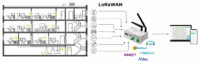
A typical LoRaWAN system for building monitoring consists of three key components:
- Sensors and Actuators
- LoRaWAN gateway
- IoT platform and/or building management system (BMS)
Sensors collect data within the building and transmit it wirelessly to a gateway. The gateway then forwards the data to a cloud platform or a building management system.
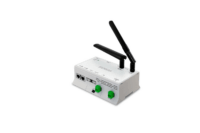
LoRaWAN gateway inside the building: Siemens Connect Box
In order to process the data from the LoRaWAN sensors, the system requires a gateway to serve as a central interface.
One solution for this task is the Siemens Connect Box. The gateway connects LoRaWAN devices within the building to IoT or building management platforms, enabling easy integration of sensor data into existing building management systems (BMS).
The Connect Box is particularly well-suited for retrofit projects and smart building applications.
The most important features include:
- Quick plug-and-play installation
- Support for numerous LoRaWAN sensors and device manufacturers
- Centralized management of IoT devices
- Supports 11 communication protocols, including BACnet, KNX, M-Bus, Modbus, and others.
- secure data transmission
- Easy integration with building management systems and cloud platforms
The Connect Box thus serves as the technical foundation for numerous building monitoring applications, ranging from indoor climate monitoring to energy optimization—all without the need for complex wiring—making it ideal for retrofitting existing buildings.
LoRaWAN sensors for building monitoring
The market offers a wide range of LoRaWAN sensors for building monitoring that can measure various parameters. Three examples of such sensors are listed below. In addition, we offer many other LoRaWAN sensors for a wide variety of applications in our m2m online store.
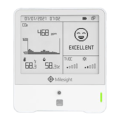
LoRaWAN 7in1 Indoor Ambient Sensor with CO2/TVOC
Milesight's AM300 series LoRaWAN sensor combines as many as seven monitoring parameters to measure indoor climate: temperature, humidity, light, CO2 concentration,HCHO/O3 content, TVOC, barometric pressure, PM2.5, PM10 and motion. Ideal for use in offices, stores, classrooms, hospitals, etc.
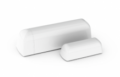
EMS LoRaWAN door/window contact sensor
The LoRaWAN door and window contact sensor from Elsys is designed for indoor use and detects whether an object such as a door or window is open or closed. Its design is very unobtrusive, making it ideal for mounting on door frames, window panes, cabinets and more.
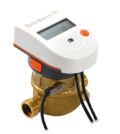
LoRaWAN compact heat meter Supercal 739
The battery-powered compact heat meter from Sontex consists of a flow sensor, removable calculator with various communication options and a pair of temperature sensors. It is used in building services and in the district and local heating sector for recording consumption-dependent heating and/or cooling energy and for individual heating cost billing; available in different variants and sizes, complies with the requirements of MID 2014/32/EU and EN 1434 Class 3.
Would you like to make your building smart?
Our colleagues would be happy to advise you during a free, no-obligation initial consultation.

m2m Germany to Make Its Debut at the Smart Country Convention 2026
Working with VEGA for Smart Flood Protection The Smart Country Convention will bring together stakeholders from government, business, and… in Berlin from October 13 to 15, 2026

SMART CITY EXPO WORLD CONGRESS in Barcelona - we will be there
From November 3 to 5, 2026, the international smart city community will once again gather at the Smart City Expo World Congress (SCEWC) in Barcelona. As one of…
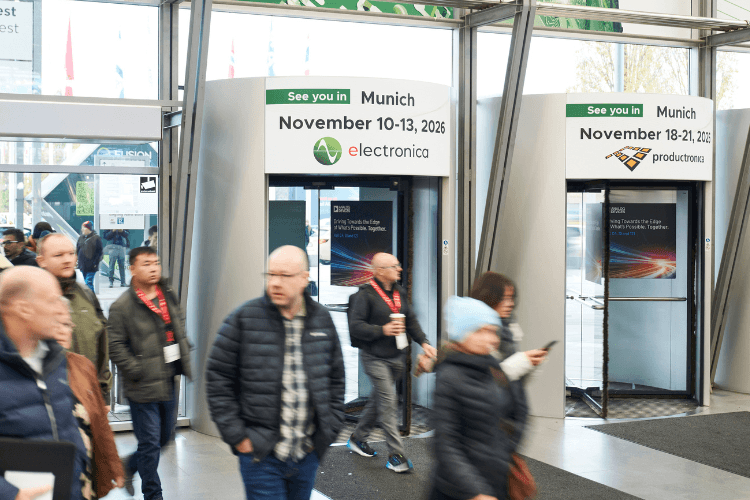
m2m Germany at electronica 2026
From November 10 to 13, 2026, the international electronics industry will once again gather at electronica in Munich. As the world’s leading trade show, it brings together manufacturers, developers, and…